

Sunday 1 November 2026 – 15:17
Ayatollah Sistani Representative Praises Iran’s Role in Promoting Islamic Spirituality
Hojatoleslam Shahrestani, representative of Grand Ayatollah Ali Sistani, has emphasized the need for coherent planning and the use of spiritual capacities to expand the culture of Itikaf in society and at the international level.
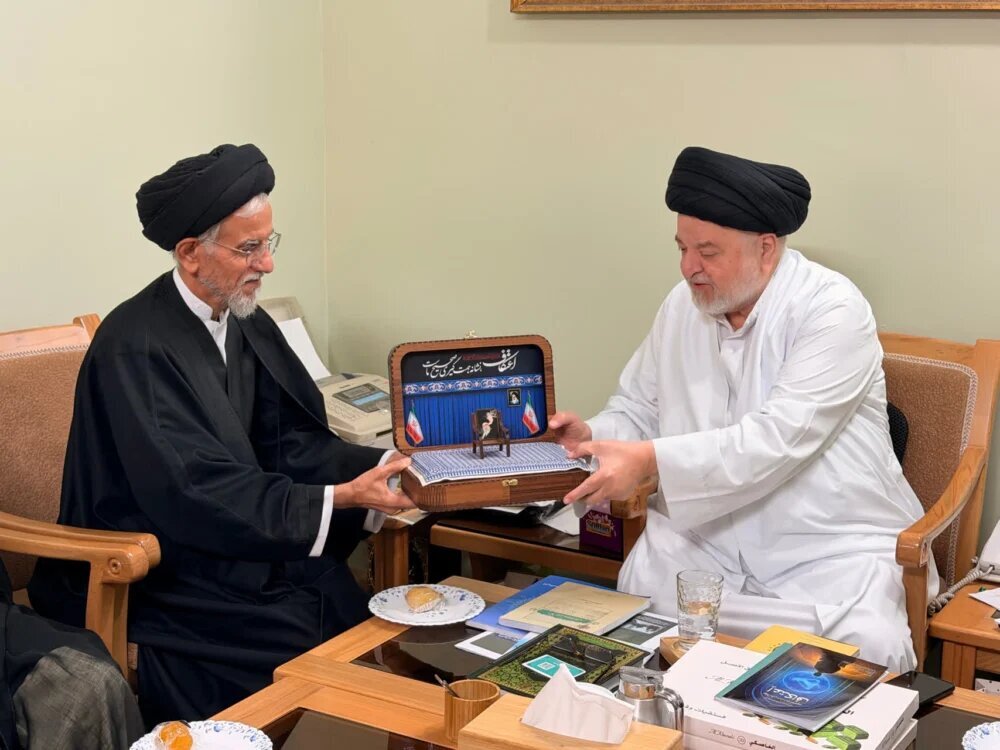
Hawzah News Agency- Hojatoleslam Seyyed Alireza Tekyeh’i, head of the Central Itikaf Headquarters, presented a report on the national Itikaf congress, the international Itikaf festival, and this year’s slogan—centered on the strategy of “the Martyr Imam, the Mission of Nation”—during a meeting with Hojatoleslam Seyyed Javad Shahrestani.
Hojatoleslam Shahrestani praised the Islamic Republic of Iran’s services in spreading Islamic culture and spirituality, saying: “The Islamic Republic has brought many services and blessings in this field, but the important point is to move based on precise, systematic, and organizational planning.” He noted that the Itikaf Headquarters has managed in recent years, through cohesion and continuous planning, to play an effective role in expanding the culture of Itikaf and its spiritual impact on society—a trend that must be preserved and strengthened.
The representative of Grand Ayatollah Sistani described the widespread public participation in Itikaf as significant, saying: “The level of participation in Itikaf, given the country’s population, is considerable and shows that this spiritual movement has been able to have an impact on society.”
Recalling examples of the influence of Ahlul Bayt (AS) teachings among followers of different religions and schools of thought, he stressed the need to present Islamic teachings properly, adding: “Spirituality has the capacity to communicate with diverse audiences without political boundaries and to pave the way for their familiarity with Ahlul Bayt (AS) teachings.”
Hojatoleslam Shahrestani recounted a memory of meeting several ambassadors from different countries, saying one ambassador spoke of his personal experience at the holy shrine of Lady Fatima Masoumeh (AS) and the spiritual effect of seeking intercession and blessing through the soil of Imam Hussain (AS)—an experience showing that the spiritual capacities of the Ahlul Bayt (AS) school can influence even those with different cultural and religious backgrounds.
The representative of Grand Ayatollah Sistani also highlighted the status of supplication and Ahlul Bayt (AS) teachings, describing Sahifa Sajjadiyya as a valuable spiritual and cultural asset of the Islamic world. He recounted examples of the book’s impact on scholars and audiences in various countries and stressed the need to introduce these teachings more widely.
“We have valuable assets in the Ahlul Bayt (AS) school, and if these teachings are presented properly and effectively to society, they can influence many audiences. Instead of focusing on marginal issues, we should concentrate on introducing spiritual realities and authentic Islamic teachings,” he said.
Shahrestani also called for expanding international Itikaf activities, noting: “The spiritual capacity of Itikaf is not limited to geographic borders, and through planning and using the capacities of active groups in different countries, this movement can be expanded to other regions of the world.”
He highlighted capacities in countries such as Iraq and Lebanon, as well as some European countries, and stressed the need to create organizational frameworks and cooperation among active cultural and religious institutions for the international development of Itikaf.
“International activities require order and planning, and in this path, the capacities of institutions such as the World Ahlul Bayt (AS) Assembly, the World Forum for Proximity of Islamic Schools of Thought, Al-Mustafa International University, and Astan Quds Razavi can be used,” he added.
Hojatoleslam Shahrestani also stressed the importance of recording and transferring the experiences of Itikaf activists and called for compiling an oral history of this spiritual movement, urging the documentation of memories and experiences of figures who have played a role in promoting Itikaf over past decades.
In conclusion, he praised the efforts of the head and staff of the Central Itikaf Headquarters, described the continuation of these activities as valuable, and wished success for those involved in promoting the culture of spirituality and Ahlul Bayt (AS) teachings.
70 Percent of Last Year’s Itikaf Participants Were Teens and Young Adults
Hojatoleslam Tekyeh’i, head of the Central Itikaf Headquarters, outlined content planning to improve the quality of Itikaf ceremonies and, citing the broad presence of teenagers and young adults, stressed the need to address the intellectual, doctrinal, and content needs of this age group.
According to the report presented at the meeting, about 1.5 million people participated in Itikaf ceremonies last year, more than 70 percent of them teenagers and young adults.
Hojatoleslam Seyyed Mohammad Baqer Tekyeh’i, deputy head of the Central Itikaf Headquarters and head of its international foundation, also presented a report on efforts to develop international communications and promote Itikaf culture in various countries.
Referring to the launch of a specialized international Itikaf working group in cooperation with the International Itikaf Foundation, he said the group operates with representatives from four continents and about 23 countries and has facilitated communication and cooperation with various countries, including Axis of Resistance states, India, Russia, and some European and African countries.
Hojatoleslam Tekyeh’i described Itikaf as an important capacity for introducing authentic Islamic spirituality globally and stressed the need to expand international activities in this field.
Hojatoleslam Lotfi-Niasar, a faculty member of the Central Itikaf Headquarters, also presented a report on the planning and quality of the 11th National Itikaf Congress and outlined the working groups and scientific and content sections implemented for the event.

Majid Poustchian

