

Sunday 1 November 2026 – 15:00
War and Rent: A Narrative of Rising Housing Prices in Europe and Street Anger
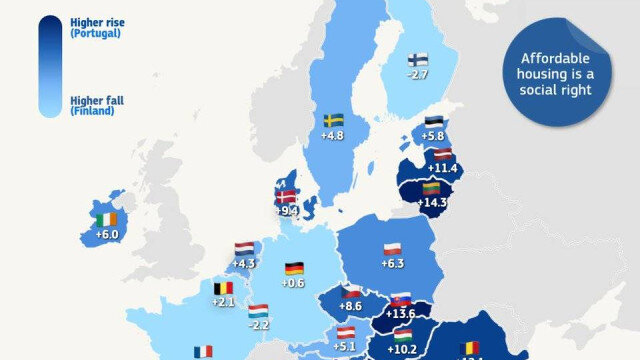
In the second quarter of 2026, housing prices in the European Union rose by 4.7 percent year-on-year; Portugal led with 16.5 percent, Bulgaria with 15.5 percent and Lithuania with 14.3 percent, while only Finland, Luxembourg and France recorded declines. On the surface, these figures suggest a healthy market, but in reality they mark the intersection of three crises: a shortage of housing supply, war-driven inflationary pressures, and a political choice that diverts public resources from “butter” to “war.”
Hawzah News Agency- Europe’s housing crisis is not the product of a simple market distortion. On one hand, supply in many urban economies has fallen behind demand; in Portugal, prices rose by about 124 percent between 2015 and 2024, almost twice the EU average, and rents nearly doubled over the same period. Tourism and foreign investment have turned part of the housing stock into short-term rentals and financial assets, intensifying pressure on tenants. But explaining the crisis through supply and demand alone is incomplete, because governments have policy tools to intervene on both sides of the market, and what prevents their use is budget priorities.
Since 2022, European countries have faced a series of external shocks: the loss of access to cheap Russian energy, US tariffs and Chinese industrial competition, which have simultaneously increased pressure on national budgets and household purchasing power. In such conditions, NATO’s commitment to raise defence spending to 5 percent of GDP by 2035 has channeled the remaining limited fiscal space even more toward weapons and military infrastructure. This is the classic guns-versus-butter choice: every euro going to expanded military capacity, military aid to Ukraine or rebuilding defence industries is a euro absent from social housing budgets, rent subsidies or the construction of affordable units.
The data show this relationship not mechanically but structurally. The countries that recorded the highest housing price growth often face serious fiscal constraints on investing in public housing.
Therefore, European protests cannot be read simply as a revolt against high prices. They express a growing awareness in which geopolitical and military costs are directly linked to the quality of daily life. An analysis in the French publication Le Monde diplomatique also points to this gap: while European leaders stress “predictable and sustainable” financial support for Ukraine, citizens face cuts in public services and rising rents. This gap erodes the legitimacy of centrist governments and opens political space for anti-system forces at both ends of the spectrum.
The important point is that war versus butter is not a zero-sum choice but a continuum; that is, a continuous spectrum with defence spending at one end and welfare spending at the other, and governments can stand at a point between them. Governments can, through progressive tax policies, action against land hoarding and targeted investment in social housing, fund defence costs without collapsing the welfare system. But what happens in practice is the easier choice: cutting welfare and housing spending, because its political cost appears lower in the short term than a wealth tax or reforming the property market. Portugal, with 16.5 percent housing price growth and street protests, shows that this political calculation fails in the long run.
Overall, the 4.7 percent rise in housing prices in the EU should not be seen as merely an economic statistic. This figure summarizes a political choice: at a time when Europe is spending for security against Russia, housing security for ordinary citizens is pushed to the margins. As long as this gap between geopolitical priorities and everyday needs is not bridged, Europe’s streets will be the scene of repeated protests whose roots lie not in a “culture of protest” but in a sense that the basic right to an affordable place to live has been ignored.
Source: iuvmpress.co

