

Wednesday 4 November 2026 – 00:06
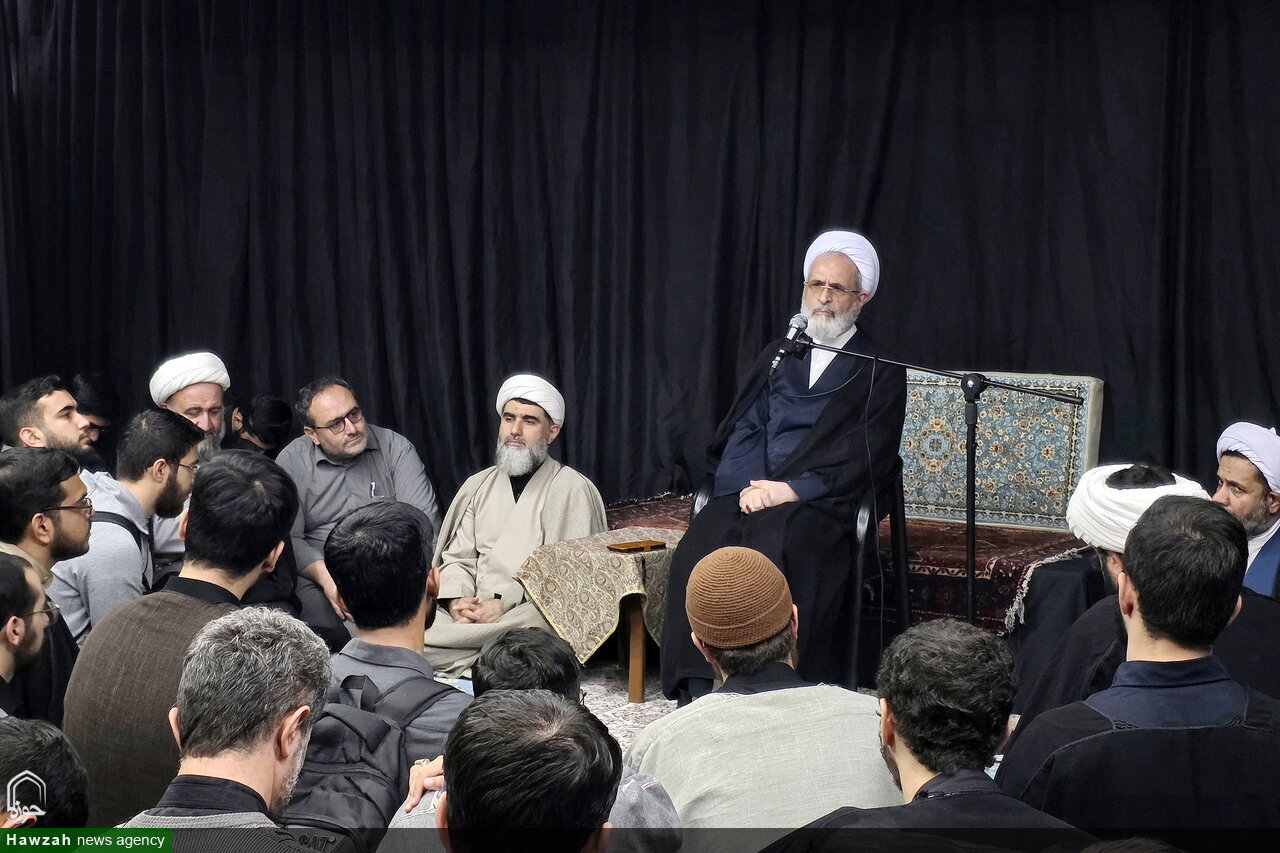
Ayatollah Arafi: Islamic Revolution the Pinnacle of 1,000 Years of Seminary History
The head of Iran’s seminaries has described the Islamic Revolution as the most significant development in the thousand-year history of the Islamic seminary, saying it has opened unprecedented global horizons for seminaries and the teachings of the Ahl al-Bayt (peace be upon them).
Hawzah News Agency- Ayatollah Alireza Arafi, head of the Islamic Seminaries and a member of Iran’s Guardian Council’s jurists, made the remarks during a visit to the Haqqani Seminary in Qom, where he addressed the institution’s officials, professors and students.
Referring to the history of the Haqqani Seminary’s establishment, Ayatollah Arafi paid tribute to those who founded the institution, including the late Mr. Ghayuri and Mr. Montazeri, and others who contributed to the project.
Scientific and Educational Standing of the Haqqani Seminary
Ayatollah Arafi highlighted the Haqqani Seminary’s distinguished position among the country’s seminaries, saying that roughly 20 seminaries in Qom and across the country enjoy a privileged status and host the elite of the seminary world. “The future of the seminary must therefore be shaped by you,” he told the students.
He added that if the top 20 institutions were to be ranked among the roughly 500 seminary centers and institutes, the Haqqani Seminary would place among the highest. “This position is both a great honor and a heavy responsibility, because the future of the seminaries must be shaped by you.”
Global Capacities of the Islamic Revolution
Describing the Islamic Revolution and the new era of the Qom seminary as having opened vast and unprecedented horizons, Ayatollah Arafi said that even if the capacities of the seminaries were multiplied a hundredfold today, they would still not be enough to meet the needs and horizons ahead.
Field Experience in the International Arena
Referring to his own field experience in the international arena and seminary missions in various countries, Ayatollah Arafi said he had been privileged to travel to dozens of countries on seminary missions, engaging deeply with issues in more than a hundred countries and studying their intellectual currents.
“With the expertise I have, I tell you that what lies before you are infinite horizons for Islam, the Islamic Revolution and the exalted divine values,” he said.
Areas Opening Up Before Us in the World
Ayatollah Arafi said he had spoken repeatedly with officials and influential figures in the system about the shifting global equations and the areas opening up before Iran. He recalled that in the early days of Dr. Mohsen Rezaei’s tenure at the Expediency Council, he had raised 11 points in a meeting in Qom, including issues abroad and the areas opening up in the world.
The head of the seminaries stressed that the current conditions, alongside serious challenges, have created rare opportunities: “Today we face great challenges, but in return, horizons and capacities have emerged that are extraordinary and unparalleled.”
Need for a Macro Perspective on Global Developments
Ayatollah Arafi urged seminarians to move beyond a narrow, local view and adopt a macro perspective on world developments: “If we go beyond a limited view of our surroundings and look at today’s world from a higher vantage point, we realize we are facing infinite tasks. For this new capacity that has emerged in the world, even hundreds of people like Martyr Motahhari would not be enough, and a thousand like him are needed to respond to these needs.”
He described a macro, strategic and global outlook as one of the key requirements for today’s seminarian, saying this demands sufficient information, deep insight and serious resolve to engage in a great struggle for the dissemination of divine teachings. The expectations placed on elite-training centers like the Haqqani Seminary are therefore very high.
Islamic Revolution: Pinnacle of Major Historical Developments in Seminaries
Turning to the great political and social developments that have arisen from the seminaries throughout history, Ayatollah Arafi said that in past eras, several major political events originated from the seminaries and produced massive political, social and cultural transformations, propelling the seminaries into new stages and spaces.
He identified the first period as the era following the end of the Minor Occultation and the age of Sheikh Mufid, when the three ancient seminaries of Baghdad, Ray and Qom took shape and a period of flourishing of Ahl al-Bayt thought and divine teachings unfolded. Sheikh Mufid, Sheikh Tusi and other great figures laid new foundations in that historical period, followed by waves of dissemination of divine teachings and the spread of Shiism.
Ayatollah Arafi identified the second major historical period as the era of Allama Hilli and Khajeh Nasir al-Din Tusi during the Mongol period, saying scholars including Allama Hilli and Khajeh Nasir al-Din Tusi rose at that time. A large number of scholars in Iraq and Iran managed the Mongol movement, such that the great invasion was managed by them, and the seminaries experienced tremendous growth and flourishing.
He cited the Safavid era as the third major historical period in the seminaries’ development, noting the presence of Muhaqqiq Karaki, Sheikh Bahai, Mulla Sadra, Mir Damad and other great figures who transformed the seminary and played an effective role in politics.
Architects of Iran’s Scientific and Political Transformation
Referring to his historical studies in recent months, Ayatollah Arafi said he had read about 130 historical books during the war period, despite displacement and various engagements, during nighttime hours.
Discussing his studies on Muhaqqiq Karaki, he said the great jurist hailed from Lebanon and came to Isfahan twice at the invitation of Safavid kings; the city was one of the most prominent scientific centers during the two centuries of the Safavid era.
Ayatollah Arafi said Muhaqqiq Karaki was one of roughly seven or eight great jurists and philosophers who changed the political equations of Iran and, in a sense, the region, leveraging the capacity of the Safavid government. Numerous scientific and cultural transformations were also achieved through him.
Referring to the role of Sheikh Bahai and other scholars who migrated from Lebanon, as well as Iranian scholars, in this historical period, he said that in the 10th and 11th centuries AH, the Isfahan seminary became one of the foremost seminaries, where a unique collection of scientific, cultural, political and social activities took shape.
Ayatollah Arafi continued that in the Isfahan seminary, a vast array of activities emerged in philosophy, theology, hadith, history, architecture, urban planning, politics, the expansion of Friday prayers, and research in various branches of jurisprudence, principles, hadith, theology and philosophy. This unique collection was achieved through the efforts of those seven or eight — roughly 10 — great scholarly and religious figures.
Ayatollah Arafi noted that this movement not only transformed Iran but also placed the seminaries in a new space and paved the way for widespread transformations.
Historical Developments of Seminaries Over More Than a Millennium
Summarizing the historical developments of the seminaries over more than a thousand years, Ayatollah Arafi said that if one leafs through the history of the seminaries, one can identify seven or eight special and important periods in which great transformations occurred in the Islamic world and the seminaries. “But what has occurred in our era, in the light of the century-long Qom movement and the Islamic Revolution, surpasses all of those developments.”
Need to Seize the Current Special Conditions
Ayatollah Arafi stressed the need to seize the current special conditions: “The transformation that has occurred in our era is very distinct and must be appreciated, because the greater the event, the greater its dangers and risks, and the more effort it requires.”
Today’s Seminarian Stands at a Preeminent and Very Special Position
Addressing the students of the Haqqani Seminary, he said: “Today’s seminarian must know that, in the continuum of the historical turning points of the seminaries, he stands at a preeminent and very special position. This position, and the transformation that began from Qom with the Islamic movement and revolution, differs from and surpasses the seven or eight great historical transformations and fateful turning points of the past.”
Ayatollah Arafi added that such a position requires a seminarian of a higher caliber — one equipped with knowledge, learning, wisdom, comprehensiveness, the ability to respond and the tools needed to fulfill great responsibilities. These are all essential conditions for a seminarian who wants to play a role at this level.
The Place of the Martyr Imam’s Thought
Referring to the place of the martyred Imam’s thought in charting such a horizon for the seminaries, Ayatollah Arafi said: “This was the very truth that our martyred and revered Imam understood more than anyone, pursued, and encouraged others to pursue. His final positions and remarks about the forward-looking and preeminent seminary reflected this same vision.”
He described the current conditions as a new point of flourishing for the seminaries and stressed: “This new point of flourishing must become more flourishing through you.”
Global Expansion of Seminaries: An Unprecedented Feature of the New Era
Explaining the differences between the current period of the seminaries and past eras, Ayatollah Arafi identified the international scope and global reach of seminary activities as one of the most important features of the new era: “In today’s conditions, there are several fundamental differences from past periods that did not exist in this form before, and these very differences determine your missions today.”
Opening of Global Horizons
Ayatollah Arafi described the opening of global horizons as the most important characteristic of the new stage: “The opening of horizons on a global scale is an unprecedented feature of this period and has no precedent in the past thousand years.”
He added: “Today, as you sit in this seminary, with this same educational and training model, more than a hundred countries around the world have drawn inspiration from Qom, and the path and tradition of seminarians and the clergy has been established in those countries.”
Referring to the geographical reach of this seminary movement, Ayatollah Arafi said: “From the depths of Africa to Europe and America, from the Caucasus to the Far East and Southeast Asia, the banner of the seminaries has been raised and a new path has been opened.”
Ayatollah Arafi paid tribute to the efforts of the first Iranian missionaries and clerics in spreading the seminaries globally, saying the founders of this movement were the same Iranian scholars dispatched to various regions of the world, with local forces gradually growing and entering the field.
A Great Army of Seminarians Worldwide: The International Legacy of the Islamic Revolution
In conclusion, Ayatollah Arafi highlighted the breadth of seminary activities in the light of the Islamic Revolution: “In the shadow of the Islamic Revolution, a great army of seminary forces has spread across the world and expanded new horizons for the seminaries, the teachings of the Ahl al-Bayt (peace be upon them) and Islamic thought. This is one of the main characteristics of the new era of the seminaries, and we all have a duty before this vast capacity and historical responsibility.”

Majid Poustchian

